Unofficial Concept

Scholar 2.0

A conceptual redesign of Google Scholar in light of today’s AI technologies.


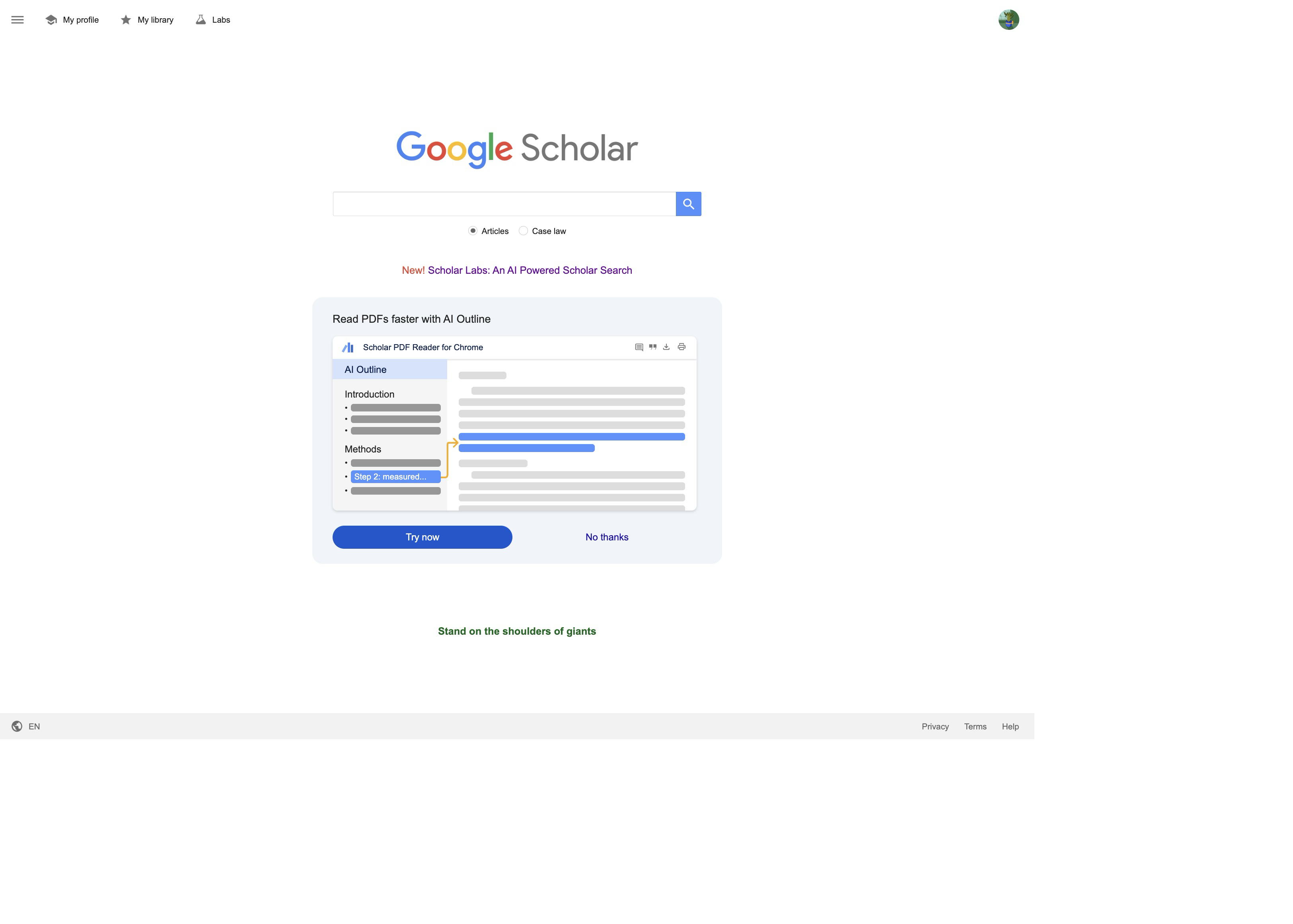
Google Scholar
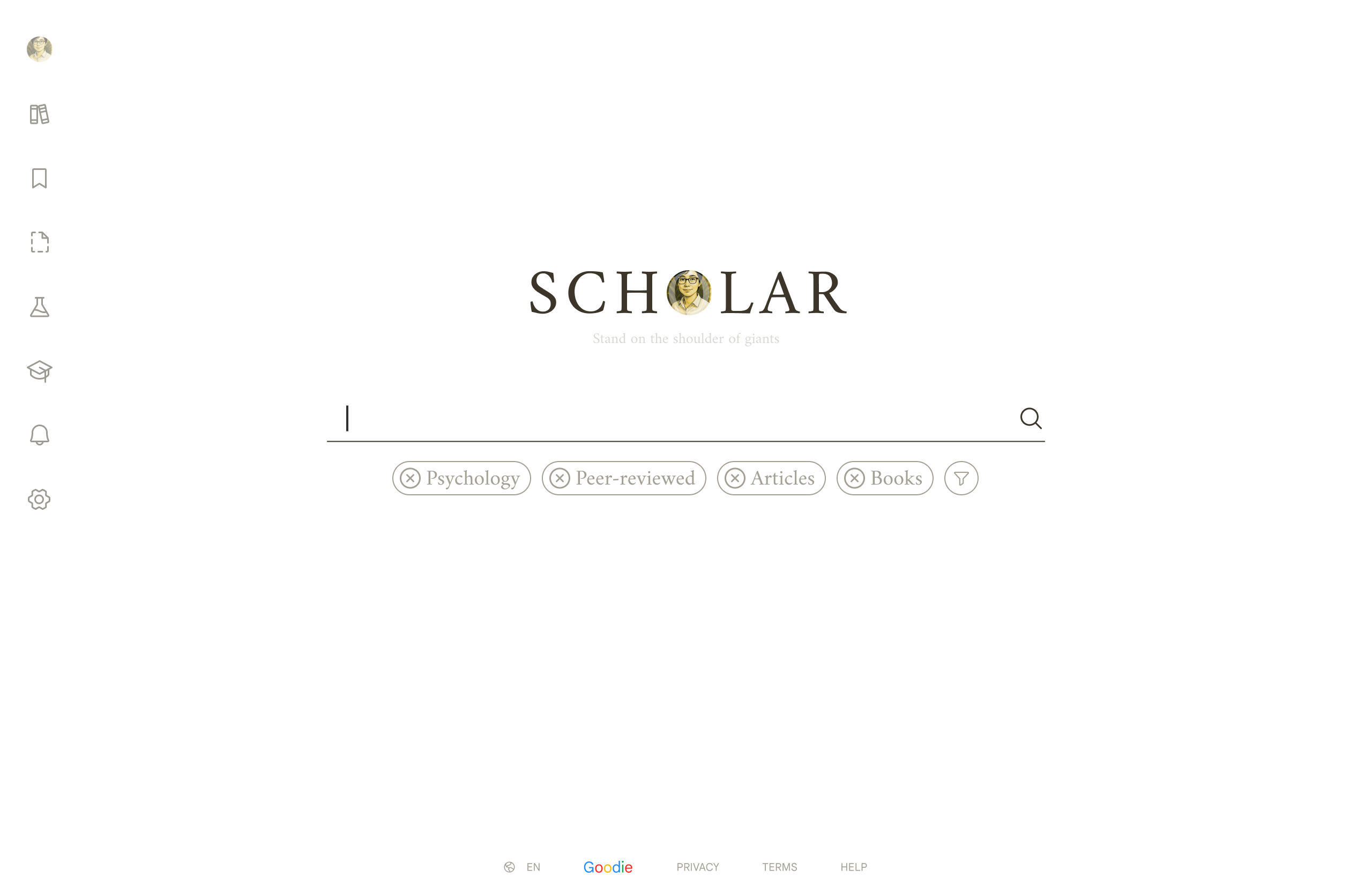
Google Scholar Concept
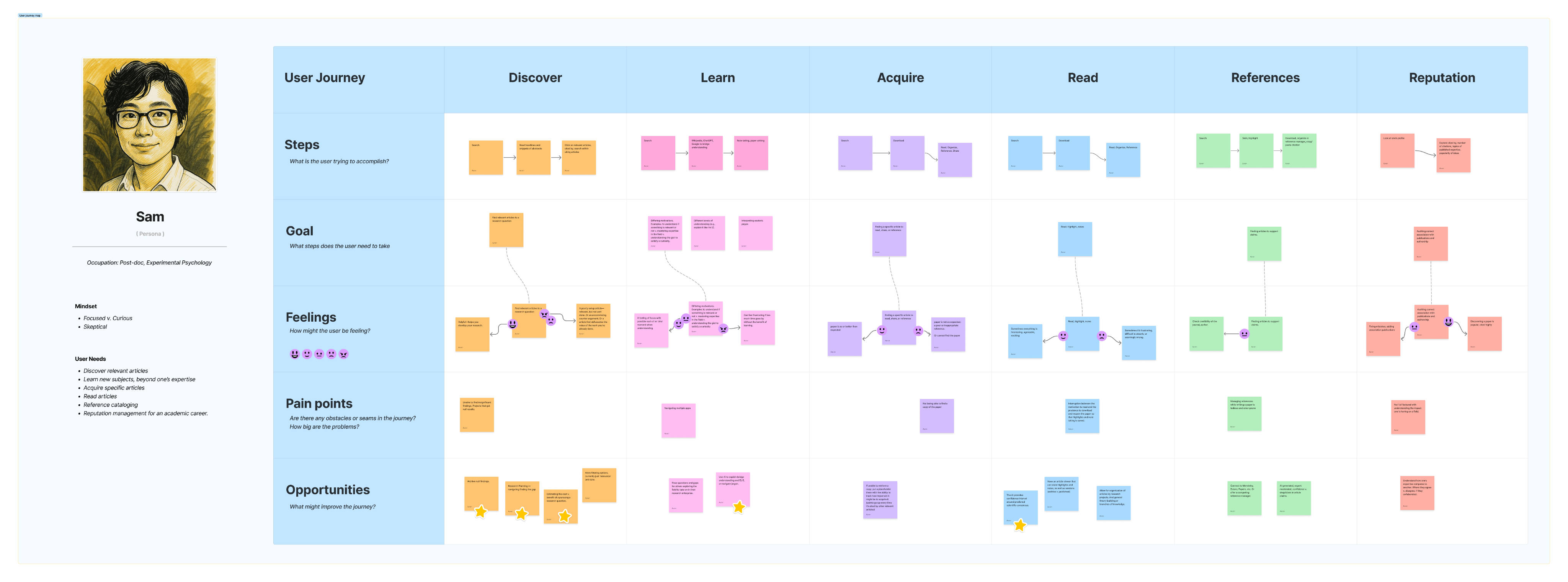
Journey mapping Google Scholar to help identify opportunities to innovate. 5 ideas are presented here.

Mapping Google Scholar’s experience for a hypothetical Psychology post-doc to help identify opportunities to innovate and focusing to design a few

  1. Navigate branches & see gaps.
  2. Esoteric jargon translator.
  3. Glean rigor, veracity, and consensus.
  4. Cost estimator for grant applications.
  5. Explore insignificant research.

See hidden academic structures.

Search results are structured—prioritizing meta-analyses for their breadth and reliability. An underlying RAG model continuously looks for landmarks as users scroll, presenting more categorically related papers. The hypothsis is that this help people find desired articles by visualizing themes and theories that connect publications, but often remain hidden.

Designed to see structures that otherwise takes advance studies to grasp.

Navigate gaps in research.

Scholarship involves identifying the valuable knowledge-gaps to fill. Scholar 2.0 tries to help by mapping papers collected for a project. Using technology like Toponymy and DataMapPlot, papers are projected as a two dimensional landscape with landmarks. The hypothesis here is that sparse v. dense maps relates to pioneering v. derivative research projects and seeing it would help researchers navigate their field more consciously.

Save articles into a space where you can keep notes and explore relationships.

Tools for skeptics.

When scholars read carefully, they’re looking to be convinced. Scholar 2.0 provides survey tools to help skeptics quickly glean credibility beyond traditional markers of credibility (e.g., citation count, authors’ reputations, institutional prestige, publishing journal’s impact factor). Three tools: Rigor (methodology, effect sizes, internal reliability, external validity), Consensus (citations which agree with the primary findings of this article), and Veracity (pose article questions and corroborate claims).

Tools for reading, note-taking, and analyzing articles.

Jargon translation.

Multidisciplinary research can be difficult to navigate because knowledge naturally becomes esoteric as disciplines advance. Scholar 2.0 help those who brave swinging between branches with tools to translate jargon as easy as any dictionary can be defined. And it’s not just one-size fits all; from neophyte to specialist, different levels of translation are offered.

Useful jargon explained and saveable for later reference.

....want to know more?

Scholarly tools designed by a scholarly designer.

About me

Unoffical Concept

TK

Explore

two people sitting on a ledge talking

Professional Work

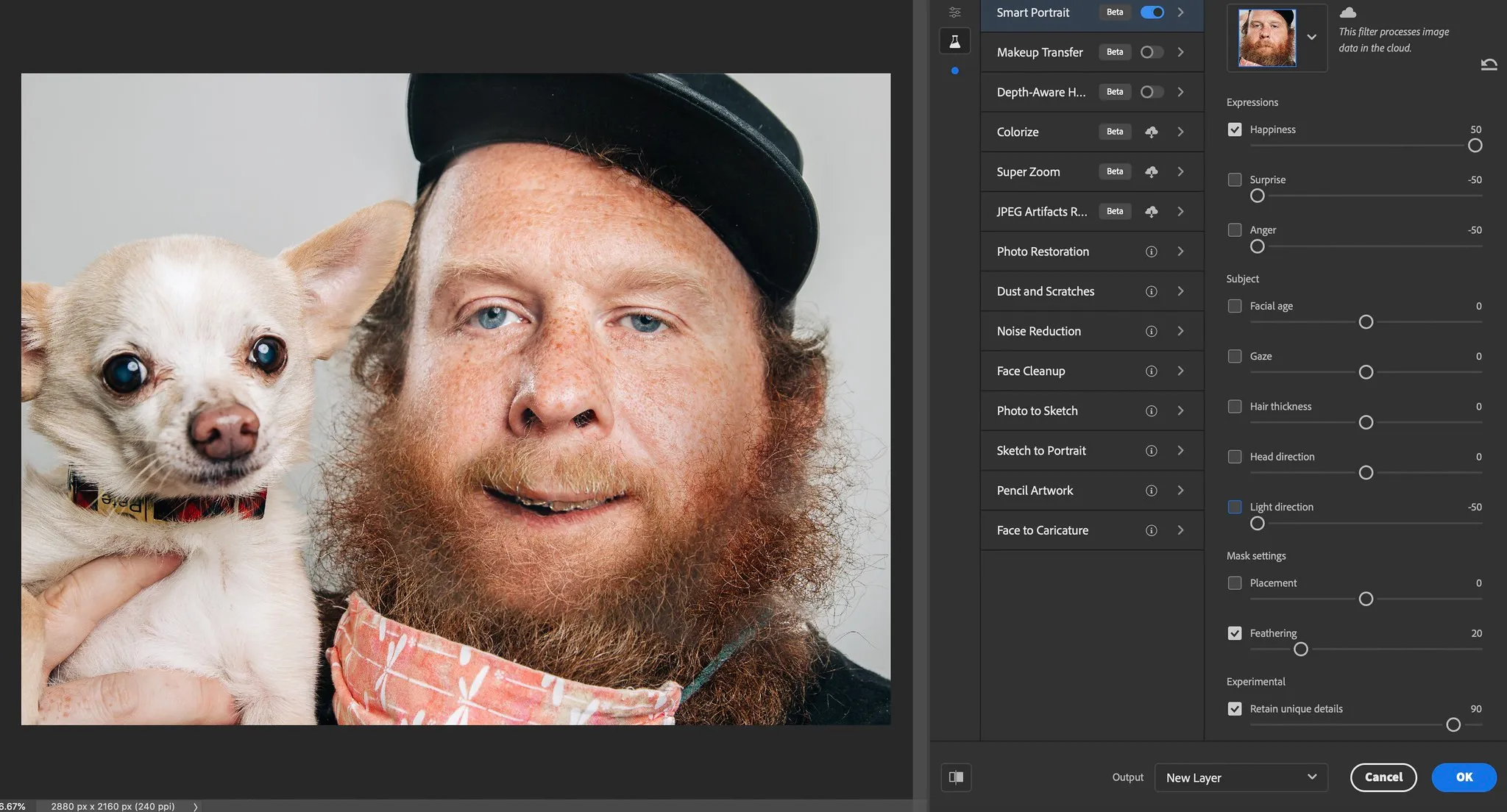
Neural Filter

Explore

Student Project

Canvas

Explore

© Aaron K Roek 2026 All Rights Reserved

Unofficial Concept

Scholar 2.0

A conceptual redesign of Google Scholar in light of today’s AI technologies.


Google Scholar
Google Scholar Concept
Journey mapping Google Scholar to help identify opportunities to innovate. 5 ideas are presented here.

Mapping Google Scholar’s experience for a hypothetical Psychology post-doc to help identify opportunities to innovate and focusing to design a few

  1. Navigate branches & see gaps.
  2. Esoteric jargon translator.
  3. Glean rigor, veracity, and consensus.
  4. Cost estimator for grant applications.
  5. Explore insignificant research.

See hidden academic structures.

Search results are structured—prioritizing meta-analyses for their breadth and reliability. An underlying RAG model continuously looks for landmarks as users scroll, presenting more categorically related papers. The hypothsis is that this help people find desired articles by visualizing themes and theories that connect publications, but often remain hidden.

Designed to see structures that otherwise takes advance studies to grasp.

Navigate gaps in research.

Scholarship involves identifying the valuable knowledge-gaps to fill. Scholar 2.0 tries to help by mapping papers collected for a project. Using technology like Toponymy and DataMapPlot, papers are projected as a two dimensional landscape with landmarks. The hypothesis here is that sparse v. dense maps relates to pioneering v. derivative research projects and seeing it would help researchers navigate their field more consciously.

Save articles into a space where you can keep notes and explore relationships.

Tools for skeptics.

When scholars read carefully, they’re looking to be convinced. Scholar 2.0 provides survey tools to help skeptics quickly glean credibility beyond traditional markers of credibility (e.g., citation count, authors’ reputations, institutional prestige, publishing journal’s impact factor). Three tools: Rigor (methodology, effect sizes, internal reliability, external validity), Consensus (citations which agree with the primary findings of this article), and Veracity (pose article questions and corroborate claims).

Tools for reading, note-taking, and analyzing articles.

Jargon translation.

Multidisciplinary research can be difficult to navigate because knowledge naturally becomes esoteric as disciplines advance. Scholar 2.0 help those who brave swinging between branches with tools to translate jargon as easy as any dictionary can be defined. And it’s not just one-size fits all; from neophyte to specialist, different levels of translation are offered.

Useful jargon explained and saveable for later reference.

....want to know more?

Scholarly tools designed by a scholarly designer.

About me

Unoffical Concept

TK

Explore

two people sitting on a ledge talking

Professional Work

Neural Filter

Explore

Student Project

Canvas

Explore

© Aaron K Roek 2026 All Rights Reserved

Unofficial Concept

Scholar 2.0

A conceptual redesign of Google Scholar in light of today’s AI technologies.


Google Scholar
Google Scholar Concept
Journey mapping Google Scholar to help identify opportunities to innovate. 5 ideas are presented here.

Journey mapping Google Scholar’s experience for a hypothetical Psychology post-doc to identify opportunities and then focusing on a few potentially high-impactful ideas to design.

  1. See hidden academic structures.
  2. Navigate gaps in research.
  3. Tools for skeptics.
  4. Jargon translation.
  5. Cost estimation.

See hidden academic structures.

Search results are structured—prioritizing meta-analyses for their breadth and reliability. An underlying RAG model continuously looks for landmarks as users scroll, presenting more categorically related papers. It’s hypothesized that this would help people find desired articles by visualizing themes and theories that connect publications, yet often remain hidden.

Designed to see structures that otherwise takes advance studies to grasp.

Navigate gaps in research.

Scholarship involves identifying the valuable knowledge-gaps to fill. Scholar 2.0 tries to help by mapping papers collected for a project. Using technology like Toponymy and DataMapPlot, papers are projected as a two dimensional landscape with landmarks. The hypothesis here is that sparse v. dense maps relates to pioneering v. derivative research projects and seeing it would help researchers navigate their field more consciously.

Save articles into a space where you can keep notes and explore relationships.

Tools for skeptics.

When scholars read carefully, they’re looking to be convinced. Scholar 2.0 provides survey tools to help skeptics quickly glean credibility beyond traditional markers of credibility (e.g., citation count, authors’ reputations, institutional prestige, publishing journal’s impact factor). Three tools: Rigor (methodology, effect sizes, internal reliability, external validity), Consensus (citations which agree with the primary findings of this article), and Veracity (pose article questions and corroborate claims).

Tools for reading, note-taking, and analyzing articles.

Jargon translation.

Multidisciplinary research can be difficult to navigate because knowledge naturally becomes esoteric as disciplines advance. Scholar 2.0 help those who brave swinging between branches with tools to translate jargon as easy as any dictionary can be defined. And it’s not just one-size fits all; from neophyte to specialist, different levels of translation are offered.

Useful jargon explained and savable for later reference.

....want to know more?

Scholarly tools designed by a scholarly designer.

About me

Unofficial Concept

TK

Explore

tk

Professional Work

Neural Filter

Explore

Student Project

Canvas

Explore